
A Fish Bone Hidden at the Tongue Base: Clearly Localized by Electronic Laryngoscopy
A patient developed throat discomfort after eating, with a clinical diagnosis of 'pharyngeal foreign body (?)'. Electronic laryngoscopy found a fish bone at the left tongue base, and the findings also recorded the condition of the nasal cavity, epiglottis, pharynx, and laryngeal structures. Dr. Xiangpeng Liu uses this to remind readers not to swallow food or drink vinegar after a bone gets stuck, but to see an otolaryngologist early so laryngoscopy can locate it before removal. De-identified laryngoscopy images are shown below.
Case facts
Clinical images
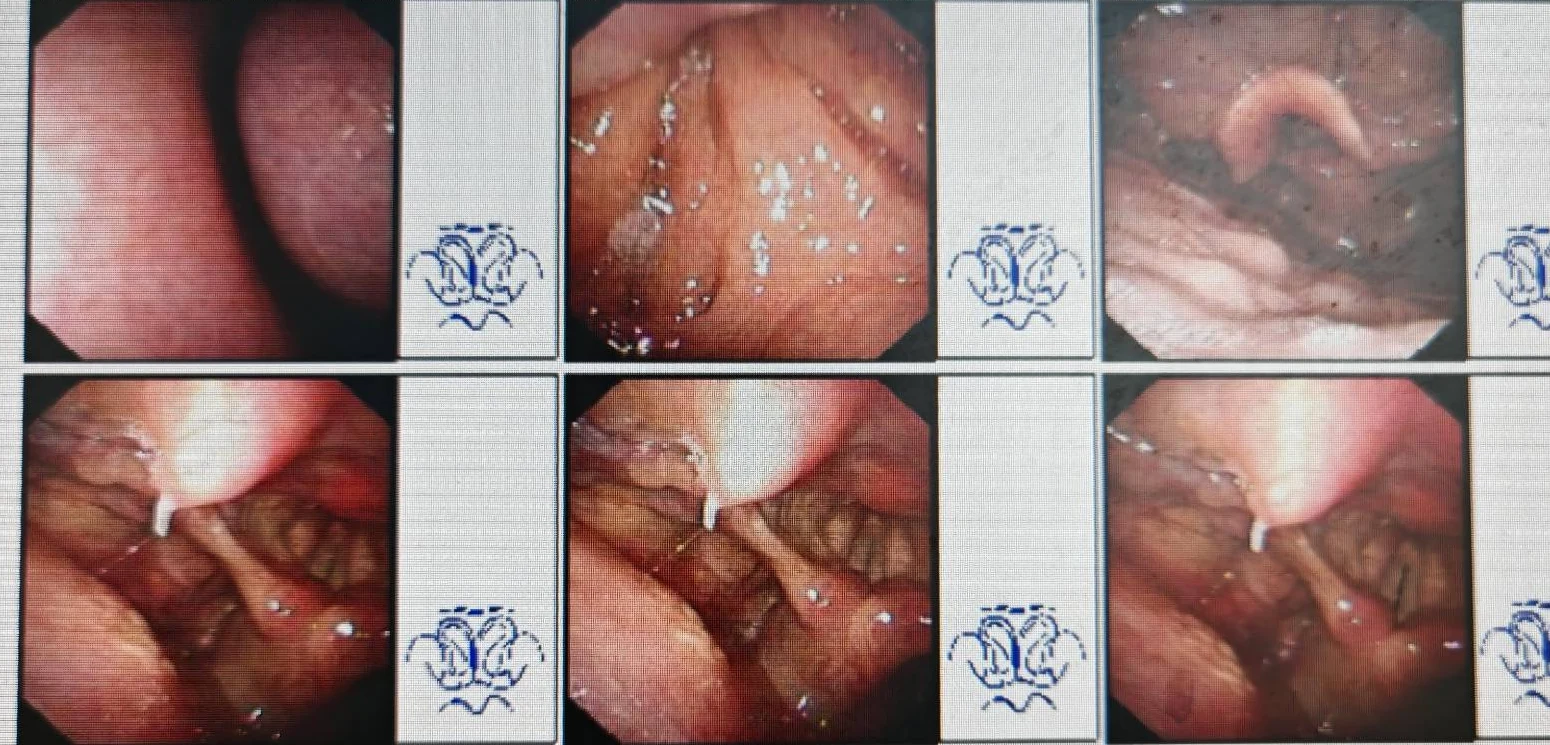
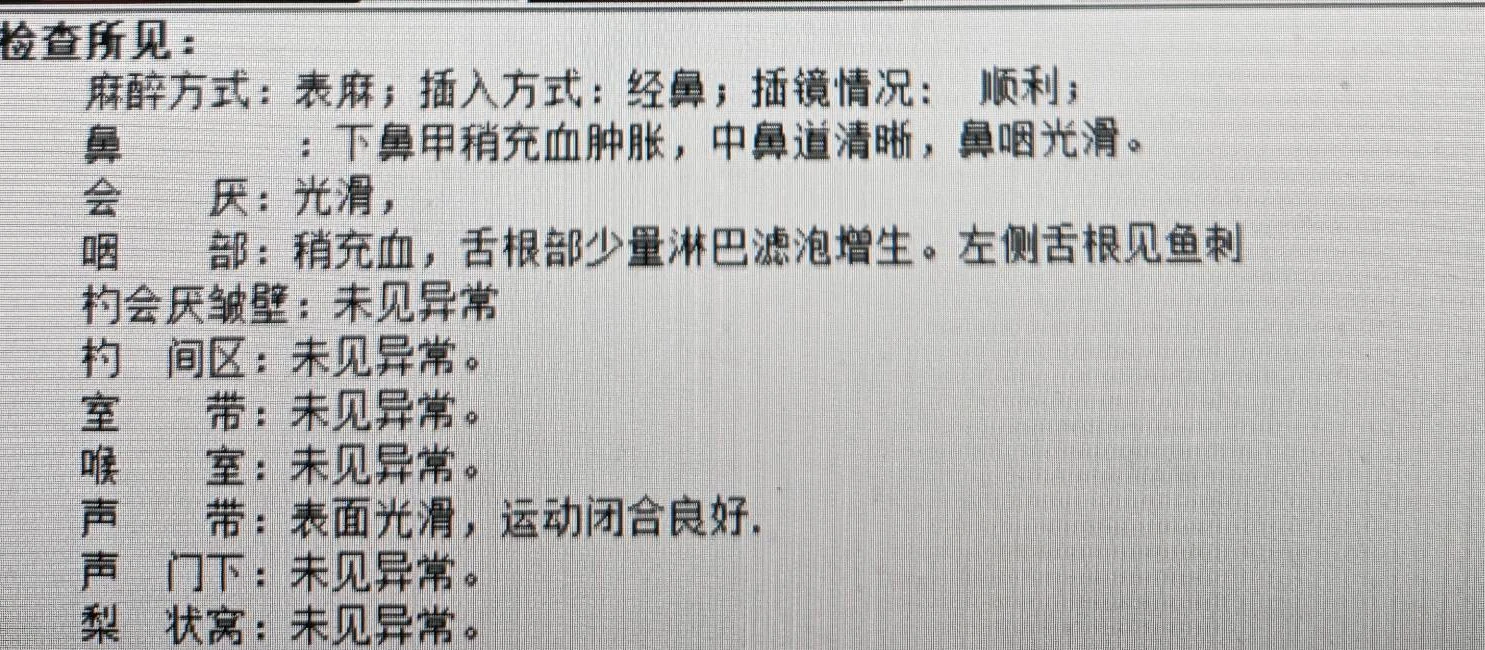
Click any image to view the original size. All images are de-identified before publication.
A fish bone lodged at the root of the tongue can be felt as a foreign body but cannot be coughed out or spat out. On electronic laryngoscopy, the position of the bone in this case was displayed clearly — at the left tongue base. The tongue base is deep and relatively insensitive, making it one of the places where fish bones most often 'hide'; laryngoscopy is usually needed to see and locate them.
The Fish Bone Was Found on Laryngoscopy
The patient presented with throat discomfort and a clinical diagnosis of 'pharyngeal foreign body (?)', then underwent transnasal electronic laryngoscopy. The examination was performed under topical anesthesia, and the scope was inserted smoothly.
The findings were recorded item by item. In the nasal cavity, the inferior turbinate was mildly congested and swollen, the middle meatus was clear, and the nasopharynx was smooth; the epiglottis was smooth; the pharynx was mildly congested with a small amount of lymphoid follicular hyperplasia at the tongue base, and a fish bone was seen at the left tongue base. The aryepiglottic folds, interarytenoid region, ventricular folds, laryngeal ventricles, subglottis, and pyriform sinuses were all normal, and the vocal cords were smooth with good movement and closure.
In other words, apart from the fish bone at the left tongue base, no obvious abnormality was seen in the remaining laryngeal structures. The position of the bone was clearly localized on laryngoscopy, which provided the basis for subsequent management.
- Clinical diagnosis: pharyngeal foreign body (?)
- Examination: transnasal electronic laryngoscopy, smooth insertion under topical anesthesia
- Key finding: fish bone at the left tongue base
- No obvious abnormality in the remaining laryngeal structures
Why Fish Bones Tend to Stay at the Tongue Base
The tongue base, tonsils, vallecula, and pyriform sinuses are the sites where fish bones most often hide. These areas are deep and relatively insensitive; once a bone lodges, there is often only a foreign-body sensation or discomfort on swallowing, and its exact location is hard to describe. Laryngoscopy is usually needed to see it clearly.
Talking, being distracted, or swallowing in a hurry while eating fish makes it easy for a bone to be swallowed along with the flesh. A bone at the tongue base sometimes shows only a tiny exposed tip — felt but impossible to remove oneself — which is why it is particularly troublesome.
If a Bone Gets Stuck, Do Not Do These Three Things
First, do not swallow rice balls or steamed buns to try to 'carry' the bone down. This may push it deeper or even perforate the esophagus, which is far more dangerous.
Second, do not drink vinegar. Vinegar stays in the esophagus for a very short time and cannot soften a fish bone; instead it irritates the already injured mucosa.
Third, do not blindly probe with your fingers or tweezers. A deeply lodged bone cannot be seen or reached, and forced probing can cause bleeding or push the bone deeper.
The correct approach is to stop eating and see an otolaryngologist as soon as possible, so the doctor can locate the bone with laryngoscopy and remove it professionally. In this case, laryngoscopy showed exactly where the bone was, giving management a clear target.
About This Report and Privacy
The image on this page is taken only from the laryngoscopy photo and the 'findings' text area of the examination report. The report header, name, age, examination number, and all other identifiable information have been cropped out. The conclusion area of the report was not fully captured, so no inference is made; the location of the bone is based on the finding 'fish bone at the left tongue base'.
The removal procedure and subsequent course are not described here; the specific care is as recorded in the consultation and medical notes. This case is published with patient consent, and the patient may request its removal at any time. This article is for health education only and does not constitute a diagnosis or treatment recommendation.
Dr. Xiangpeng Liu: Eating Fish Slowly Matters More Than Anything
Another fish bone at the tongue base. A stuck fish bone may seem minor, but improper handling can cause real trouble. Prevention is simple: eat fish slowly and attentively, chew thoroughly, and avoid talking or laughing with food in your mouth. When serving fish to older adults and children, take extra care to pick out the bones.
Once you feel a bone stuck, do not struggle with it yourself — come to the hospital early for laryngoscopy. Laryngoscopy shows where the bone is and how deep it has gone, so removal can be both quick and safe.
— Dr. Xiangpeng Liu · Department of Otolaryngology–Head and Neck Surgery · Laryngology Group
Privacy, consent and limits
Images are taken from the examination or report and de-identified: names, examination numbers, hospital identifiers and report headers are removed. Publication follows patient consent, and a patient may request that a report be taken down at any time.
This page records the findings and management of one patient. It does not claim efficacy, does not predict outcomes, and is not medical advice.
Chinese original & English translation
This report is the English edition of a case first published on Dr. Liu’s Chinese website. Read the Chinese original at liuyishi.com ↗
The Chinese site also carries the full case library, 32 disease hubs and more than 600 answered questions. Both editions are maintained by the same clinical team.
Questions about this report
Are these case photographs identifiable?
No. All images are de-identified: patient names, examination numbers, hospital identifiers and report headers are removed before publication, and the report is published with patient consent.
Does a case report prove a treatment works?
No. A case report is a descriptive account of one patient’s findings and management. It cannot establish effectiveness or predict an individual outcome.
Where is the Chinese original?
The Chinese original of this report is published on Dr. Liu’s Chinese website at https://www.liuyishi.com/news/yw-fishbone-tongue4-20261119.html.
Medical disclaimer: This knowledge base is general information for people researching head and neck tumours, not a diagnosis or treatment plan. It does not replace an examination by a qualified physician. Survival figures are population averages, not predictions for an individual. Treatment and cost estimates for China are illustrative only and must be confirmed in writing after your records have been reviewed. If you have a symptom lasting more than two to three weeks, see a doctor promptly.
Ask about a similar condition
International patients can send pathology, imaging and a short summary for a written preliminary opinion before travelling to China.
Treatment in China Send an enquiry