
Right Vocal Cord Polyp: Online Specialist Booking, Diagnosed in Clinic Today, Surgery Scheduled for the Next Day
A patient with hoarseness specifically registered for Dr. Xiangpeng Liu's outpatient clinic today through an online channel. Electronic laryngoscopy showed a congested right vocal cord with a fish-belly-like bulge at its middle third, good mobility, and mildly incomplete closure, consistent with a right vocal cord polyp. Surgery has been scheduled for the next day. De-identified laryngoscopy images are shown below.
Case facts
Clinical images
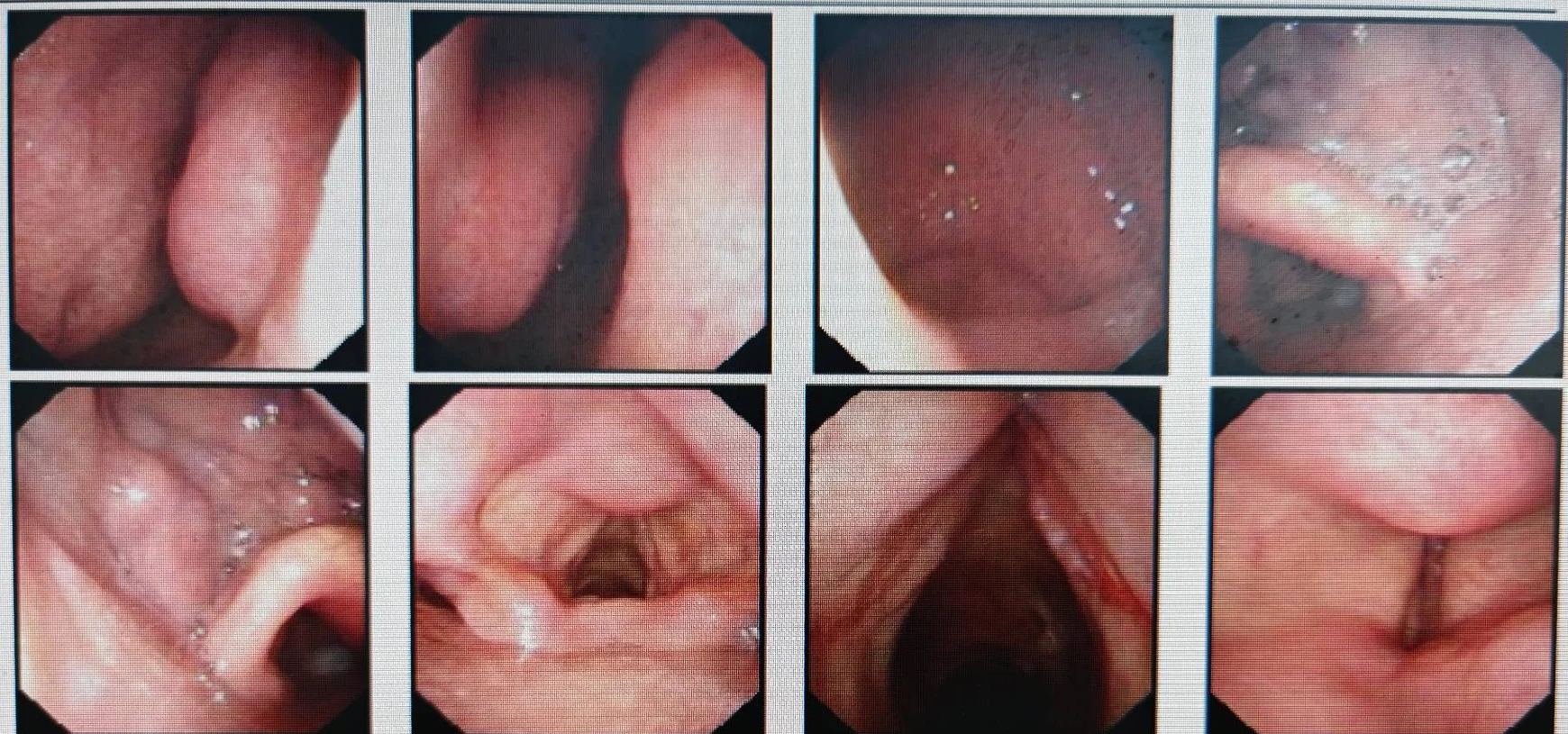
Click any image to view the original size. All images are de-identified before publication.
Hoarseness is one of the most common complaints in an otolaryngology clinic. Rather than simply visiting the nearest clinic, this patient registered specifically for Dr. Xiangpeng Liu's outpatient clinic today through an online channel. Laryngoscopy revealed a fish-belly-like bulge at the middle third of the right vocal cord, which, together with the hoarseness, is consistent with a right vocal cord polyp. Preoperative assessment has been completed in clinic and surgery is scheduled for tomorrow. This page presents the de-identified laryngoscopy image and the route to care for readers with similar concerns.
Route to Care: From an Online Search to the Clinic
The patient learned about Dr. Xiangpeng Liu's specialty online and then registered specifically for his clinic because of hoarseness. This route is increasingly common: patients first review a doctor's expertise online, then book a targeted appointment, which saves time and puts them in front of the right specialist at the first visit.
In clinic, hoarseness is never handled by simply 'prescribing something and waiting'. Persistent hoarseness may be caused by a vocal cord polyp, vocal cord nodules, chronic laryngitis, or other lesions that require attention. Electronic laryngoscopy is the key step that makes the vocal cords visible.
- Chief complaint: hoarseness
- Route to care: registered for Dr. Xiangpeng Liu's clinic after an online search
- Clinic workup: electronic laryngoscopy completed
Laryngoscopy: A Fish-Belly-Like Bulge at the Middle Third of the Right Vocal Cord
The electronic laryngoscopy report records: congested right vocal cord, fish-belly-like bulge at the middle third, good mobility, mildly incomplete closure. The epiglottis was smooth; the ventricular folds, laryngeal ventricles, and subglottis were normal; the pharynx was mildly congested with a small amount of lymphoid follicular hyperplasia at the tongue base. The clinical diagnosis was hoarseness.
'Fish-belly-like bulge' is a typical laryngoscopic description of a vocal cord polyp. Polyps usually arise at the junction of the anterior and middle thirds of the vocal cord and appear as translucent, pedunculated or broad-based swellings shaped like the rounded belly of a small fish. They prevent the vocal cords from closing fully during phonation, causing hoarseness and vocal effort. 'Good mobility' in the report means vocal cord movement is unaffected, while 'mildly incomplete closure' explains the source of the hoarseness.
- Congested right vocal cord with a fish-belly-like bulge at the middle third
- Good vocal cord mobility, mildly incomplete closure
- Smooth epiglottis; no abnormalities in the ventricular folds, laryngeal ventricles, or subglottis
- Clinical diagnosis: hoarseness
Treatment Plan: Diagnosed in Clinic, Surgery Scheduled for the Next Day
Based on the symptoms and laryngoscopic findings, the clinic assessment is complete and surgery has been scheduled for the next day. Once a vocal cord polyp is clearly diagnosed and symptoms are significant, early treatment is generally recommended; the longer it persists, the harder it becomes to correct chronic vocal cord irritation and compensatory vocal habits.
The standard procedure for a vocal cord polyp is minimally invasive resection under general anesthesia via suspension laryngoscopy, with an operating microscope when needed. There is no facial incision, and the operative field is clear with limited trauma. The exact extent and method depend on the preoperative assessment and intraoperative findings; details of this case's surgery and postoperative course will be updated once available.
This record covers the diagnosis and preoperative stage only; surgery has not yet taken place. Postoperative status, pathology results, and follow-up laryngoscopy will be added honestly after subsequent visits, with no conclusions drawn in advance.
What to Know About Vocal Cord Polyps
A vocal cord polyp is a benign growth on the vocal cord and does not become cancerous. It is common in people who use their voice frequently or with poor vocal technique, and in those with irritating factors such as smoking or laryngopharyngeal reflux. The typical feature is persistent hoarseness that does not improve with rest.
Small polyps may first be managed with strict voice rest and voice therapy, but for larger polyps, marked hoarseness, or failed conservative treatment, surgery is an effective option. A satisfactory voice outcome depends not only on the surgery itself but also on strict postoperative voice rest and correction of vocal habits, which requires the patient's active cooperation.
- Benign lesion; does not become cancerous
- Typical symptoms: persistent hoarseness, vocal effort
- Minimally invasive surgery may be considered for obvious polyps or failed conservative treatment
- Standardized voice rest and voice therapy after surgery are key to recovery
About Privacy
The image on this page is taken only from the laryngoscopy photo area of the examination report. The report header, name, examination number, inpatient number, examining doctor, and all other identifiable information have been cropped out.
This case is published with patient consent, and the patient may request its removal at any time.
Dr. Xiangpeng Liu: Do Not Ignore Hoarseness — Use Laryngoscopy to See Clearly Before Deciding on Treatment
When hoarseness persists, many people assume it is 'internal heat' or 'pharyngitis' and buy lozenges or throat remedies on their own. But hoarseness has many causes — vocal cord polyps, vocal cord nodules, chronic laryngitis, and even lesions that need greater attention — and symptoms alone cannot distinguish them. Electronic laryngoscopy directly shows the shape, movement, and closure of the vocal cords and is the most important step in determining the cause.
That this patient found the clinic online shows how clearly patients now seek specialty care. The fish-belly-like bulge at the middle third of the right vocal cord, together with hoarseness, makes the diagnostic reasoning straightforward. Good vocal cord mobility suggests the lesion is still localized, which is exactly why early treatment matters: the earlier and more localized the lesion, the simpler the management and the more favorable the conditions for voice recovery.
It is worth stressing that surgery for a vocal cord polyp is only the first step. Strict postoperative voice rest, correction of vocal habits, and management of triggers such as reflux are what prevent recurrence and truly restore the voice. I will review the recovery with the patient at follow-up laryngoscopy, and the results will be recorded honestly.
— Dr. Xiangpeng Liu · Department of Otolaryngology–Head and Neck Surgery · Laryngology Group
Privacy, consent and limits
Images are taken from the examination or report and de-identified: names, examination numbers, hospital identifiers and report headers are removed. Publication follows patient consent, and a patient may request that a report be taken down at any time.
This page records the findings and management of one patient. It does not claim efficacy, does not predict outcomes, and is not medical advice.
Chinese original & English translation
This report is the English edition of a case first published on Dr. Liu’s Chinese website. Read the Chinese original at liuyishi.com ↗
The Chinese site also carries the full case library, 32 disease hubs and more than 600 answered questions. Both editions are maintained by the same clinical team.
Questions about this report
Are these case photographs identifiable?
No. All images are de-identified: patient names, examination numbers, hospital identifiers and report headers are removed before publication, and the report is published with patient consent.
Does a case report prove a treatment works?
No. A case report is a descriptive account of one patient’s findings and management. It cannot establish effectiveness or predict an individual outcome.
Where is the Chinese original?
The Chinese original of this report is published on Dr. Liu’s Chinese website at https://www.liuyishi.com/news/sd-polyp-20261119.html.
Medical disclaimer: This knowledge base is general information for people researching head and neck tumours, not a diagnosis or treatment plan. It does not replace an examination by a qualified physician. Survival figures are population averages, not predictions for an individual. Treatment and cost estimates for China are illustrative only and must be confirmed in writing after your records have been reviewed. If you have a symptom lasting more than two to three weeks, see a doctor promptly.
Ask about a similar condition
International patients can send pathology, imaging and a short summary for a written preliminary opinion before travelling to China.
Treatment in China Send an enquiry