
Three Surgeries Tomorrow in a Dedicated Operating Room · One After Another, a Full Day
On November 20, three surgeries were scheduled for Dr. Xiangpeng Liu, and the operating room department assigned a dedicated operating room so that the three procedures could be completed one after another in the same room: functional neck dissection for a localized left neck mass, partial laryngectomy for a laryngeal mass, and excision of a laryngeal lesion under suspension laryngoscopy for a vocal cord mass. This article records the preoperative schedule and planned procedures and provides background information on neck and laryngeal masses. The surgeries have not yet been performed; intraoperative findings and postoperative results are outside the scope of this article.
Case facts
Clinical images
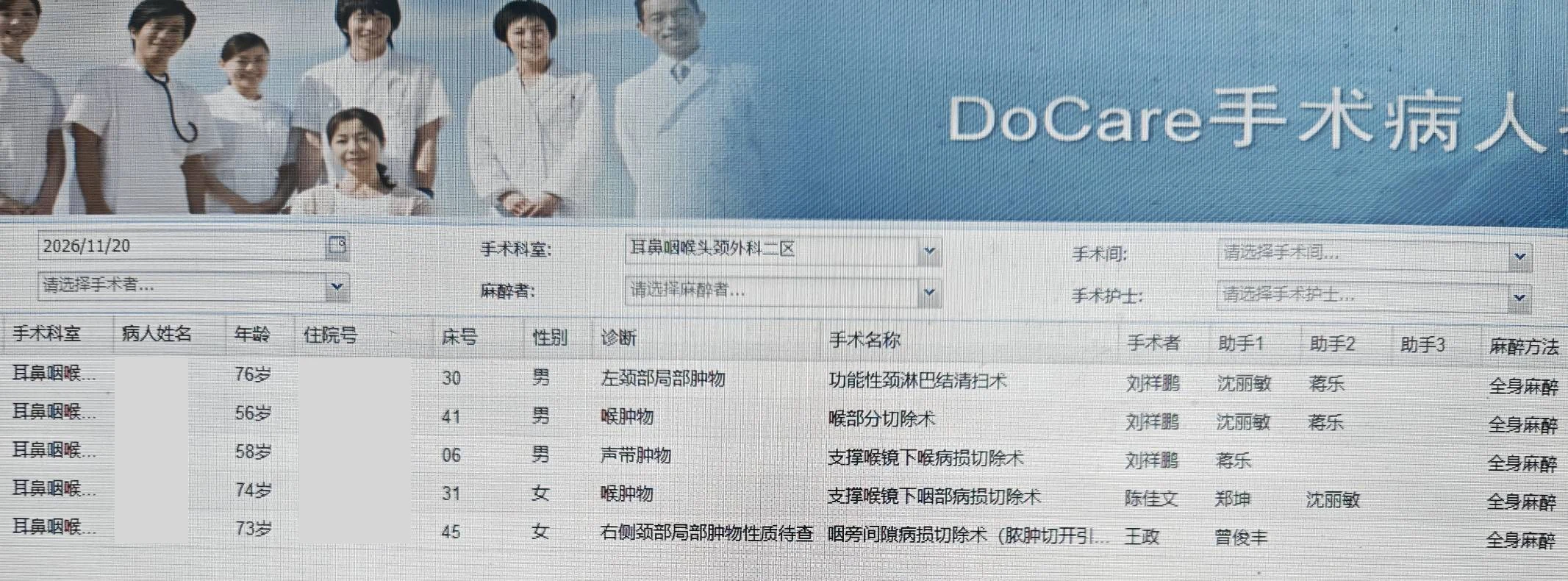
Click any image to view the original size. All images are de-identified before publication.
Tomorrow (November 20) is a fully booked surgical day: three surgeries are scheduled for Dr. Xiangpeng Liu, and the operating room department has allocated a dedicated operating room for them, to be completed one after another in the same room. The three procedures address a localized left neck mass, a laryngeal mass and a vocal cord mass, involving functional neck dissection, partial laryngectomy and lesion excision under suspension laryngoscopy. This article records only the preoperative schedule and planned procedures and offers brief background information on neck and laryngeal masses. The surgeries have not yet been performed, and intraoperative findings and outcomes are outside the scope of this article.
One Dedicated Operating Room, Three Surgeries Back to Back
The surgical schedule for November 20 shows three surgeries listed under Dr. Xiangpeng Liu. A dedicated operating room was allocated for these three cases, to be completed sequentially in the same room.
Reserving a single operating room benefits both patients and the department: the room is dedicated to these three surgeries for the whole day, allowing smoother coordination among the team, anesthesia and the operating room without switching between rooms. The order of cases is of course coordinated by the operating room based on surgical grade, anesthesia and patient condition—allocating a dedicated room here is the result of that coordination.
- Surgery date: 2026-11-20
- All three surgeries performed by Dr. Xiangpeng Liu
- A dedicated operating room reserved, with the three cases performed sequentially
- All under general anesthesia
Surgery 1: Localized Left Neck Mass · Functional Neck Dissection
The first procedure addresses a localized left neck mass using functional neck dissection. Neck dissection is a common procedure in head and neck surgery; 'functional' emphasizes removing the lymph nodes that need to be addressed while preserving important cervical vessels, nerves and non-target structures as much as possible, balancing oncologic safety with functional preservation.
To clarify, the diagnosis column on the schedule reads 'localized left neck mass', an imaging or clinical descriptive diagnosis that does not represent the final pathological nature. Whether the mass is benign or malignant, its origin and its extent must be judged from preoperative workup, intraoperative findings and postoperative pathology; this article makes no speculation.
- Site: localized left neck mass
- Procedure: functional neck dissection
- Principle: remove target lymph nodes while preserving vessels, nerves and normal structures
- Nature undetermined: the diagnosis column is descriptive; final nature depends on postoperative pathology
Surgery 2: Laryngeal Mass · Partial Laryngectomy
The second procedure addresses a laryngeal mass using partial laryngectomy. The key in laryngeal surgery is to preserve the voice, breathing and swallowing functions of the larynx as much as possible while ensuring a safe margin for managing the lesion. The exact extent of resection is individualized according to lesion site, size, vocal cord mobility and preoperative assessment.
Likewise, 'laryngeal mass' is only a description, not a final diagnosis. It may be a benign lesion or one requiring further management; its nature must be clarified by pathology. This article draws no conclusion about its nature.
- Site: laryngeal mass
- Procedure: partial laryngectomy
- Principle: preserve voice, breathing and swallowing while managing the lesion
- Nature undetermined: final nature depends on postoperative pathology
Surgery 3: Vocal Cord Mass · Resection Under Suspension Laryngoscopy
The third procedure addresses a vocal cord mass using excision of a laryngeal lesion under suspension laryngoscopy. This transoral approach has no skin incision; under general anesthesia with microscope/endoscopic exposure, the vocal cord lesion is resected. It offers clear visualization, precise manipulation and relatively limited trauma, and is a commonly used approach for vocal cord lesions.
This type of surgery is often used for vocal cord lesions requiring treatment, including benign or precancerous lesions; the specific indications and extent are decided by the surgeon based on the lesion and preoperative assessment. Vocal cord surgery demands high precision, aiming to manage the lesion while preserving vocal cord vibration and closure as much as possible to maintain voice quality.
- Site: vocal cord mass
- Procedure: excision of laryngeal lesion under suspension laryngoscopy
- Features: transoral, no skin incision, clear exposure, precise manipulation
- Goal: manage the lesion while preserving vocal cord vibration and closure
About the Term 'Mass'
In surgical schedules and many examination reports, terms such as 'mass', 'space-occupying lesion' and 'lesion' are common. They are descriptive, meaning 'an abnormal finding was detected here', and in themselves do not imply benign or malignant.
Clarifying the nature usually requires a comprehensive judgment from preoperative workup, and in many cases the final word comes from postoperative pathology. So seeing 'mass' is no cause for panic, but it should not be taken lightly either—the proper approach is to investigate thoroughly, have the physician explain the plan clearly, and then decide together.
None of the three surgeries described in this article has yet been performed; the planned procedures are preoperative arrangements, and the actual extent and method are subject to intraoperative findings and postoperative pathology.
About Privacy and Images
The accompanying image is a screenshot of the surgical scheduling system. Patient names and inpatient numbers are fully redacted; only de-identified clinical information such as sex, diagnosis, procedure and surgical team is retained for case sharing.
This case is published with patient consent, and the patient may request its removal at any time.
Dr. Xiangpeng Liu: Three Surgeries and a Dedicated Operating Room Reflect Team Coordination
There are three surgeries tomorrow, with a dedicated operating room allocated so the three can be done back to back in the same room. This arrangement depends on coordination among the operating room, anesthesia and nursing teams—reserving the room for the whole day means less waiting for patients.
The three surgeries involve different sites—neck, larynx and vocal cord—and different procedures. Whether it is neck dissection, partial laryngectomy or precise manipulation under suspension laryngoscopy, the principle is the same: address the problem that needs managing while preserving normal structures and function as much as possible. Surgery in the head and neck especially demands this balance of 'complete removal while retaining function'.
A reminder: the word 'mass' on the schedule is only a description, not a final diagnosis. Whether it is benign or malignant, its origin and its extent all need to be clarified step by step with investigations, often with postoperative pathology as the final word. So do not frighten yourself at the word 'mass', but do not ignore it either—listening to the physician explain the plan and cooperating with the workup is the most reliable approach.
— Dr. Xiangpeng Liu · Department of Otolaryngology–Head and Neck Surgery · Head and Neck & Laryngology Section
Privacy, consent and limits
Images are taken from the examination or report and de-identified: names, examination numbers, hospital identifiers and report headers are removed. Publication follows patient consent, and a patient may request that a report be taken down at any time.
This page records the findings and management of one patient. It does not claim efficacy, does not predict outcomes, and is not medical advice.
Chinese original & English translation
This report is the English edition of a case first published on Dr. Liu’s Chinese website. Read the Chinese original at liuyishi.com ↗
The Chinese site also carries the full case library, 32 disease hubs and more than 600 answered questions. Both editions are maintained by the same clinical team.
Questions about this report
Are these case photographs identifiable?
No. All images are de-identified: patient names, examination numbers, hospital identifiers and report headers are removed before publication, and the report is published with patient consent.
Does a case report prove a treatment works?
No. A case report is a descriptive account of one patient’s findings and management. It cannot establish effectiveness or predict an individual outcome.
Where is the Chinese original?
The Chinese original of this report is published on Dr. Liu’s Chinese website at https://www.liuyishi.com/news/ops-day-20261120.html.
Medical disclaimer: This knowledge base is general information for people researching head and neck tumours, not a diagnosis or treatment plan. It does not replace an examination by a qualified physician. Survival figures are population averages, not predictions for an individual. Treatment and cost estimates for China are illustrative only and must be confirmed in writing after your records have been reviewed. If you have a symptom lasting more than two to three weeks, see a doctor promptly.
Ask about a similar condition
International patients can send pathology, imaging and a short summary for a written preliminary opinion before travelling to China.
Treatment in China Send an enquiry