
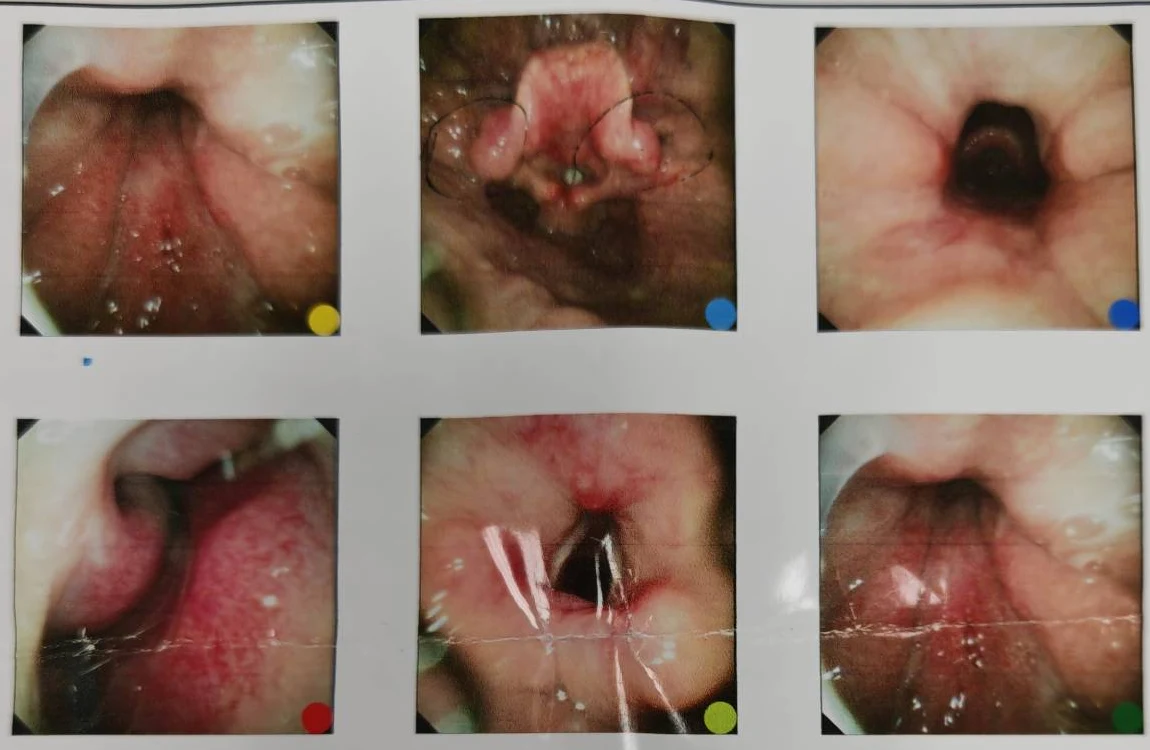
Bilateral Epiglottic Cysts: Coblation Resection and Postoperative Follow-Up Laryngoscopy
Cyst-like swellings on both aryepiglottic folds were completely resected by Dr. Xiangpeng Liu on 2026-11-17 using l…
Read case →Also known as: Laryngeal cyst · Vallecular cyst · Epiglottic retention cyst
An epiglottic cyst is a benign, mucus-filled swelling on the epiglottis or in the vallecula. Small cysts may be found incidentally; larger ones cause a foreign-body sensation, muffled voice or swallowing difficulty. Symptomatic cysts are removed endoscopically, often with coblation or laser, and the tissue is sent for pathology.
Cysts in this region can be bilateral and can occasionally affect the airway, so size and location on laryngoscopy guide how urgently they are treated.
Recurrence is uncommon after complete removal of the cyst wall.
These de-identified cases illustrate how this condition is assessed and treated in our department. Each report includes the original clinical images, published with patient consent.
Cyst-like swellings on both aryepiglottic folds were completely resected by Dr. Xiangpeng Liu on 2026-11-17 using l…
Read case →Two-to-three-week rule: a persistent ear, nose or throat symptom — especially one-sided blockage, bleeding, hoarseness or a neck lump — should be examined by an ENT specialist with an endoscope rather than treated repeatedly as a cold.
Endoscopic cyst removal is usually a short-stay procedure; Chinese ENT centres can provide English laryngoscopy images before and after treatment plus a pathology report.
See the full international patient pathway →
What you pay: the hospital’s normal medical charges only — no separate fee for the arrangement, the station pickup or the surgeon. The hospital explains its charges to you in writing once your records have been reviewed.
An epiglottic cyst is a benign cystic lesion under the mucosa of the epiglottis, filled with mucus-like material, like a 'blister' on the throat's 'lid.' The vast majority are benign and do not become cancerous. Small cysts may cause no symptoms at all, while large ones cause a foreign-body sensation, voice changes, and swallowing discomfort. Key warning: a very large cyst can block the laryngeal inlet, causing breathing difficulty, stridor, or even suffocation, requiring urgent treatment.
Epiglottic cysts mainly result from blocked gland ducts or chronic inflammation. Congenital: abnormal development of glandular ducts in the epiglottic mucosa causes secretion buildup, seen mostly in infants. Acquired: long-term pharyngitis, epiglottitis, or acid reflux irritates and blocks the ducts, seen mostly in adults. Think of it like a 'wen' on the skin. When a skin gland blocks, a small lump forms; when an epiglottic gland blocks, a cyst grows on the 'lid.' Almost all are benign, so cancer is not a concern.
Symptoms depend on cyst size. Small cysts may be completely silent, found incidentally on examination. Common symptoms: a foreign-body sensation in the throat (the most frequent, feeling something is there), voice changes (muffled or huskier), and swallowing discomfort (a sense of obstruction). Emergency signals: sudden breathing difficulty, stridor, worsening swallowing difficulty, or inability to eat. Go to the emergency department immediately.
No. An epiglottic cyst is a benign lesion with an extremely low risk of cancer. Its contents are mucus-like material, not tumor cells. However, left untreated it can grow, and a large cyst may obstruct the laryngeal inlet and cause breathing difficulty. A small, stable, symptom-free cyst can be observed, while a large or symptomatic one should be removed. Key point: it will not turn into cancer, but it may grow and affect breathing.
Protect the throat by avoiding excessive voice use, drinking plenty of water to stay moist, and treating chronic pharyngitis promptly. Control reflux by not eating within three hours of bedtime, having smaller, more frequent meals, and cutting back on sweets, coffee, and strong tea. Core advice: quit smoking and alcohol, have regular checkups, and get a laryngoscopy promptly if you notice a foreign-body sensation or other throat discomfort.
The two are completely different. An epiglottic cyst is a benign, slow-growing cystic lesion with mild symptoms (foreign-body sensation) and is not urgent. Epiglottitis is an acute infectious inflammation with sudden onset and severe symptoms (severe sore throat, breathing difficulty, high fever); it is an ENT emergency needing immediate care, and can be life-threatening. The key difference: epiglottitis is 'acute, severe, dangerous,' while the cyst is 'chronic, mild, stable.'
A small epiglottic cyst usually does not affect speech. The epiglottis sits at the laryngeal inlet above the vocal cords and does not take part in cord vibration. A large cyst may alter the resonance chamber, making the voice muffled or huskier, but this is not true 'hoarseness.' Shortly after surgery, swelling may temporarily change the voice, recovering in one to four weeks. Marked hoarseness warrants further vocal cord examination.
Electronic laryngoscopy is the gold standard for diagnosing an epiglottic cyst. One look tells the story. The scope passes through the nose to directly view the epiglottis, taking about three to five minutes, minimally invasive and painless. A laryngeal CT may be done if needed to assess size and extent. Removed tissue is routinely sent for pathology to confirm benignity, with results in about five to seven days. The path is: symptoms, laryngoscopy, cyst found, then observation or surgery.
Laryngoscopy is minimally invasive with only mild discomfort. Topical anesthetic is sprayed into the nose and throat (one to two minutes), then a flexible scope passes through the nose to view the larynx (three to five minutes). The whole process takes five to ten minutes, after which you can go home and resume normal activity. The sensation is a mild foreign-body feeling, not pain.
Diet progression after surgery: days 1-3 liquids (porridge soup, juice, milk), days 4-7 semi-liquids (soft noodles, steamed egg custard), weeks 1-2 soft foods (soft bread, fish), and weeks 2-4 a normal diet. Avoid hot foods, hard foods, spicy irritants, alcohol and tobacco, forceful coughing, and strenuous exercise. Good dietary progression means faster wound healing and fewer complications.
Recovery usually takes two to four weeks. Hospitalization covers days 1-3, basic recovery takes one to two weeks, full recovery two to four weeks, and strenuous exercise can resume after one month. Exact timing varies by person; the key is strict adherence to the dietary progression and your doctor's instructions.
Surgery does not affect the voice. The epiglottis is at the laryngeal inlet above the vocal cords and does not take part in cord vibration, so removal does not change voice quality. Shortly after surgery, mild muffling from laryngeal swelling may occur (recovering in one to four weeks), but this is not hoarseness. For singers: avoid loud singing for two weeks, gradually resume vocal practice after two weeks, and fully recover after one month. There is no need to worry about a 'worse voice.'
Treatment is either watchful waiting or minimally invasive surgery. Observation suits small, symptom-free cysts. Surgery is for cysts larger than 1 cm, with obvious symptoms, or rapid growth, with a success rate above 95%. The choice: a small, asymptomatic cyst can be watched; a large or symptomatic one should be removed.
Not necessarily. A small cyst can simply be observed, with laryngoscopy repeated every six to twelve months. Like a small mole on the skin, if it does not grow or change, it need not be treated. About 70% of small cysts stay stable long term and need no surgery.
Simple aspiration is not recommended, because the cyst wall remains and fluid quickly reaccumulates, giving a very high recurrence rate. The correct approach is complete surgical removal of the cyst together with its wall. It is like peeling an orange: take the skin off with the fruit, since leaving the skin means a new orange can grow. If the cyst becomes infected and forms an abscess, aspiration or drainage may first control the infection, then surgery follows once inflammation settles. Aspiration alone treats the symptom, not the cause.
Surgery must be done under general anesthesia, because the operative site is deep in the larynx and requires suspension laryngoscopy to expose the epiglottis, which local anesthesia cannot achieve. Benefits of general anesthesia: the patient is completely pain-free, muscles are relaxed for the procedure, and aspiration and laryngospasm are avoided. It is very safe. Modern anesthetics are metabolized quickly, and a professional anesthesiologist monitors throughout. There is no need to fear that general anesthesia 'harms the body.'
The operation itself is completely painless under general anesthesia. Afterward, throat discomfort is present for days 1-3 (worse on swallowing), gradually eases on days 4-7, and is basically gone by one to two weeks. Full recovery takes two to four weeks. Pain can be eased with analgesics, cold liquid foods, and neck ice packs. Compared with tonsil surgery, epiglottic cyst surgery is usually less painful.
Hospitalization is two to three days. The process: admission the day before for tests, a 30-60 minute procedure under general anesthesia on the day, one to two days of observation, then discharge. Preparation: fast for six to eight hours, stop anticoagulants, complete blood tests, coagulation studies, ECG, and chest X-ray, sign the consent form, prepare cold liquid foods, and postpone surgery if there is a cold or fever.
An infected epiglottic cyst can form an epiglottic abscess, causing severe sore throat, swallowing difficulty, fever, and breathing difficulty. It is an emergency requiring immediate care. Management: anti-infection treatment (antibiotics plus steroids), incision and drainage if needed, then elective cyst removal once inflammation settles. An epiglottic abscess can obstruct the airway and be life-threatening, so do not delay.
Risks fall into four groups. General anesthesia risks: drug allergy, airway management, and cardiovascular or cerebrovascular events. Systemic risks: bleeding, infection, deep vein thrombosis, and worsening of underlying disease. Local incision risks: postoperative edema causing airway obstruction, bleeding, infection, epiglottic insufficiency, recurrence, and dental or throat injury. Finally, postoperative pathology may differ from the preoperative diagnosis (about 5-10%). Most risks are uncommon and can be prevented through assessment, meticulous technique, and monitoring.
Surgery is generally safe, but possible risks include epiglottic edema (5-10%, resolving in two to three days), swallowing difficulty (temporary, recovering in one to two weeks), voice changes (recovering in one to four weeks), and recurrence (5-10%, which can be treated again). The key to lowering risk is choosing an experienced surgeon, a thorough preoperative evaluation, and strict adherence to aftercare instructions.
Overall bleeding risk is low, about 1-2%. Prevention: apply ice to the neck for the first 24 hours and avoid vigorous coughing; for one to two weeks strictly follow the diet progression, avoid forceful coughing and throat clearing, avoid strenuous activity, and avoid anticoagulants such as aspirin. If you notice frequent swallowing or vomiting fresh blood, seek emergency care immediately.
The recurrence rate is about 5-10%. To prevent it, choose an experienced surgeon to ensure complete removal of the cyst wall, treat reflux after surgery, quit smoking and alcohol, and have regular checks. Even if it recurs, the same minimally invasive procedure can be repeated without affecting the outcome. The rate is low, and recurrence is treatable.
Follow-up: laryngoscopy at one month, a recurrence check at six months, and an annual routine laryngoscopy (especially if symptoms occur). In daily life, drink plenty of water, avoid spicy irritating foods, quit smoking and alcohol, and actively treat chronic throat inflammation and gastroesophageal reflux. Regular follow-up is the key safeguard against recurrence and for detecting problems early.
Quitting both is strongly advised. Smoking and drinking are important triggers of chronic pharyngitis and epiglottitis; they aggravate irritation to the epiglottic mucosa and may promote cyst growth or postoperative recurrence. Alcohol also stimulates acid reflux, further damaging the mucosa. Quitting helps not only prevent the cyst but also improve overall throat health.
Start with a remote review of your records. A written opinion should come before any travel decision.
What to send Send an enquiryMedical disclaimer: This knowledge base is general information for people researching head and neck tumours, not a diagnosis or treatment plan. It does not replace an examination by a qualified physician. Survival figures are population averages, not predictions for an individual. Treatment and cost estimates for China are illustrative only and must be confirmed in writing after your records have been reviewed. If you have a symptom lasting more than two to three weeks, see a doctor promptly.