
Laryngoscopic Removal of a Fish Bone · A Video Walkthrough of the Procedure
A fish bone lodged in the pharynx was clearly localized under the magnified view of laryngoscopy: forceps approached, grasped and steadily removed it. This procedure recording presents in full view a process previously seen only in written reports. Dr. Xiangpeng Liu reminds readers: when a fish bone gets stuck in the throat, do not swallow rice or drink vinegar — see an ENT specialist early and have the bone located with laryngoscopy before removal, which is the safest approach.
Procedure video
Video is de-identified and published with patient consent. It documents what was visible during the procedure; it is not an edited claim of outcome.
Case facts
Clinical images
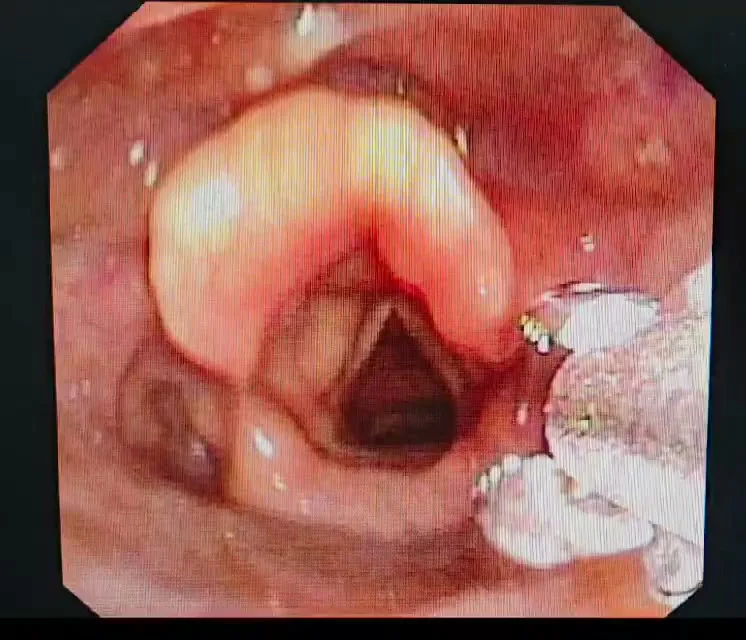
Click any image to view the original size. All images are de-identified before publication.
What does a fish bone stuck in the throat look like, and how does a doctor remove it? This laryngoscopic procedure video gives a direct answer: in the magnified view, forceps approach the slender bone step by step, grasp it, and draw it out steadily. The whole process takes less than twenty seconds, resting on a clear view of the location and confidence in placing the forceps.
A Video Showing the Entire Removal Process
This video records the laryngoscopic removal of a fish bone from the pharynx. It begins with the laryngoscopic view: the glottis is exposed, and the surrounding mucosa shows localized congestion with a small amount of surface blood — common findings associated with a retained foreign body and the grasping procedure.
Foreign-body forceps are then passed through the mouth and advanced toward the bone under the magnified view. Once the position is confirmed, the tips grasp the fish bone and draw it out steadily; at the end of the video, the extracted bone can be seen placed on gauze — a slender sliver, the very source of the foreign-body sensation and swallowing discomfort it had caused in the throat.
The value of laryngoscopy is direct here: it turns a deep, hidden location into a visible field, allowing the doctor to place forceps on a clear target rather than probing blindly. This is why a stuck fish bone should not be managed at home.
- Localizing the pharyngeal fish bone under magnified laryngoscopy
- Passing foreign-body forceps through the mouth to grasp and remove the bone
- The extracted fish bone placed on gauze, slender and clearly visible
- Localized congestion and blood traces on the glottic mucosa
Why the Fish Bone Must Be Seen Clearly Before Removal
After a fish bone gets stuck, the foreign-body sensation often cannot be pinned to a specific location. Sites such as the tongue base, tonsils, vallecula and pyriform sinus are deep and relatively insensitive; once a bone embeds there it may leave only a vague discomfort that cannot be coughed or spat out.
The pharyngeal mucosa is also thin and rich in blood vessels, with important structures such as the vocal cords and glottis nearby. Placing forceps blindly without a clear location can push the bone deeper or cause mucosal injury and bleeding. Laryngoscopy magnifies the view and fixes the location, making removal both safe and efficient.
Three Things Not to Do When a Fish Bone Is Stuck
First, do not swallow rice balls or steamed buns in an attempt to 'wash' the bone down. This can push the bone deeper or even puncture the esophagus, carrying greater risk.
Second, do not drink vinegar. Vinegar remains in the esophagus for only a very short time and cannot soften the bone; instead it may irritate mucosa that is already damaged.
Third, do not probe blindly with a finger or tweezers. A deeply lodged bone cannot be seen or reached, and forced probing can cause bleeding or push it deeper.
The correct approach is to stop eating and see an otolaryngologist promptly, where the doctor can localize the bone with laryngoscopy and remove it professionally. As shown in the video, a clear location and confident instrument placement make the procedure both quick and steady.
About This Video and Privacy
The video on this page shows only the laryngoscopic view and contains no identifying information such as the patient's face, name or examination number; the original audio track has been removed, and the page cover image is taken directly from the video.
This post presents only what is visible in the video; no personal information such as age or date of visit is added, and no inference is made about subsequent recovery. This case is published with patient consent, and the patient may request its removal at any time. This article is for health education only and does not constitute diagnostic or treatment advice.
Dr. Xiangpeng Liu: Seeing Clearly Is the First Principle of Fish Bone Removal
The message of this video is simple: the key to managing a stuck fish bone is not 'pulling hard' but 'seeing clearly before removing'. Laryngoscopy turns a deep location into a direct visual field, and only when the doctor places forceps on a clear target can removal be both quick and safe.
Eating fish slowly and attentively, and helping children and older family members remove the bones, can avoid the vast majority of such problems. If a bone does get stuck, do not swallow rice or drink vinegar; coming early for laryngoscopy is the simplest and safest course.
— Dr. Xiangpeng Liu · Department of Otolaryngology–Head and Neck Surgery · Laryngology Group
Privacy, consent and limits
Images are taken from the examination or report and de-identified: names, examination numbers, hospital identifiers and report headers are removed. Publication follows patient consent, and a patient may request that a report be taken down at any time.
This page records the findings and management of one patient. It does not claim efficacy, does not predict outcomes, and is not medical advice.
Chinese original & English translation
This report is the English edition of a case first published on Dr. Liu’s Chinese website. Read the Chinese original at liuyishi.com ↗
The Chinese site also carries the full case library, 32 disease hubs and more than 600 answered questions. Both editions are maintained by the same clinical team.
Questions about this report
Are these case photographs identifiable?
No. All images are de-identified: patient names, examination numbers, hospital identifiers and report headers are removed before publication, and the report is published with patient consent.
Does a case report prove a treatment works?
No. A case report is a descriptive account of one patient’s findings and management. It cannot establish effectiveness or predict an individual outcome.
Where is the Chinese original?
The Chinese original of this report is published on Dr. Liu’s Chinese website at https://www.liuyishi.com/news/yw-fishbone-removal-20261122.html.
Medical disclaimer: This knowledge base is general information for people researching head and neck tumours, not a diagnosis or treatment plan. It does not replace an examination by a qualified physician. Survival figures are population averages, not predictions for an individual. Treatment and cost estimates for China are illustrative only and must be confirmed in writing after your records have been reviewed. If you have a symptom lasting more than two to three weeks, see a doctor promptly.
Ask about a similar condition
International patients can send pathology, imaging and a short summary for a written preliminary opinion before travelling to China.
Treatment in China Send an enquiry