
Resection of a Left Vocal Cord Polyp · Good Vocal Cord Mobility on Postoperative Review, Discharged Smoothly
A female patient with a left vocal cord polyp was admitted on November 3, underwent surgery on November 4, and had a follow-up electronic laryngoscopy on November 5 showing postoperative changes of the left vocal cord, mild surface redness and swelling, and good mobility; the patient was discharged the same day. De-identified preoperative and follow-up laryngoscopic images are shown below.
Case facts
Clinical images
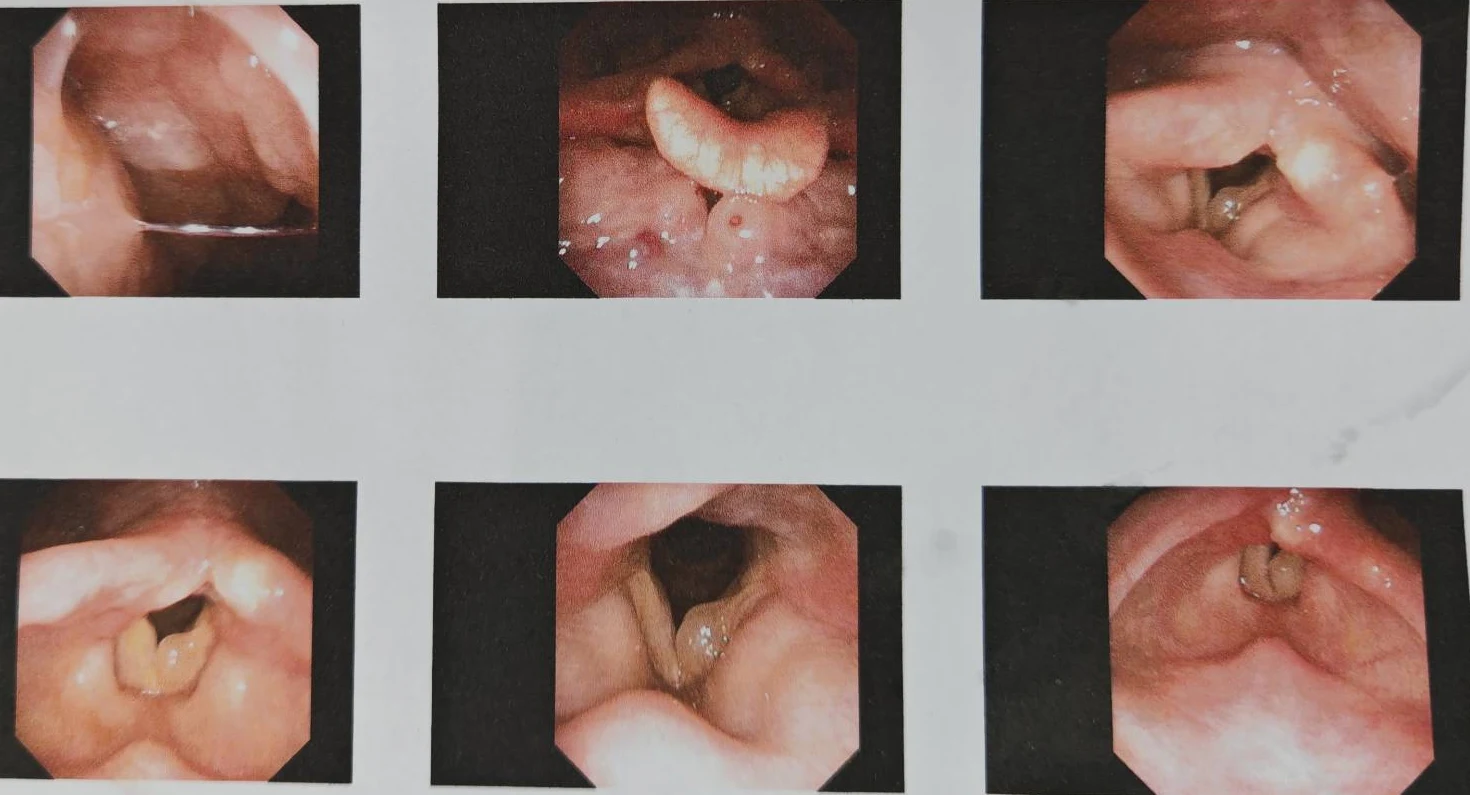
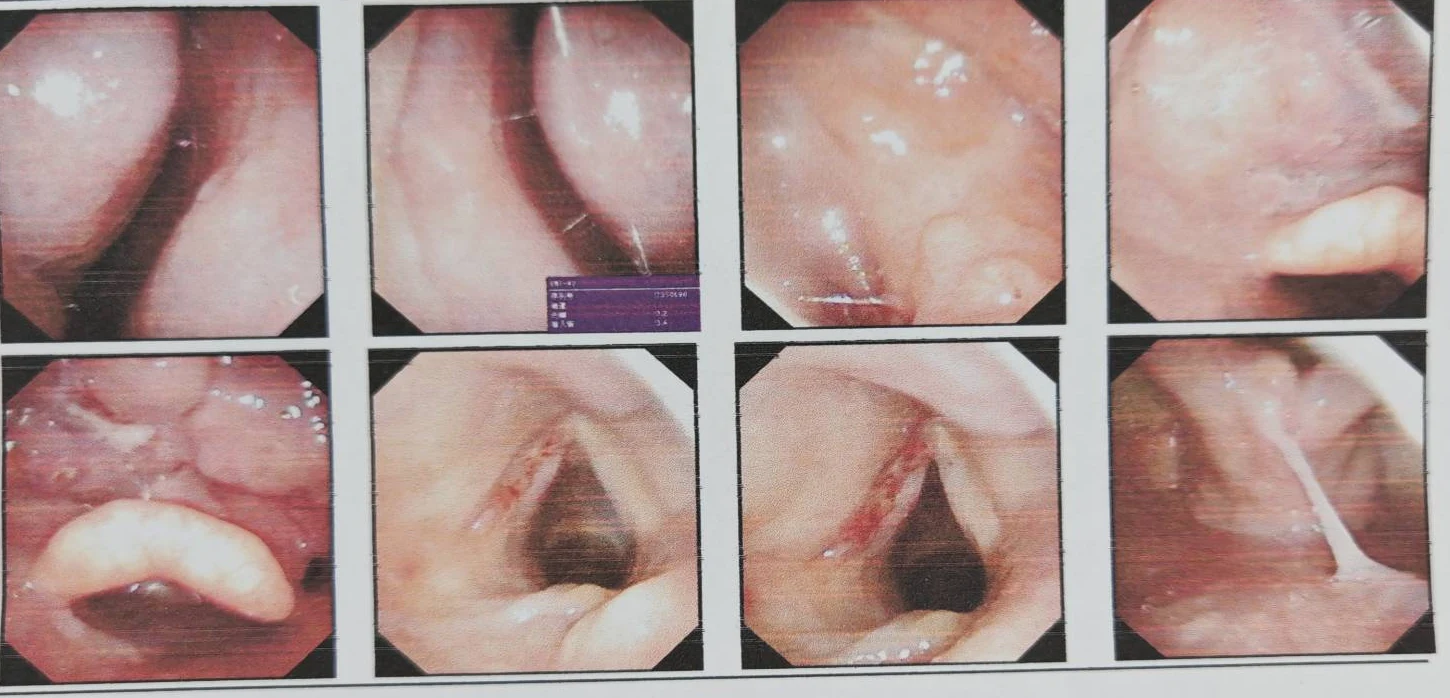
Click any image to view the original size. All images are de-identified before publication.
Hoarseness is a common complaint in ENT outpatient clinics, and vocal cord polyps are one of its common causes. This female patient had a polypoid lesion on the left vocal cord on preoperative electronic laryngoscopy, was admitted on November 3, underwent surgery on November 4, and had a follow-up electronic laryngoscopy on November 5 showing postoperative changes of the left vocal cord, mild surface redness and swelling, and good mobility; the patient was discharged smoothly the same day. This page presents a de-identified comparison of the preoperative and follow-up laryngoscopic images as a reference for readers with similar concerns.
Preoperative: A Polypoid Lesion on the Left Vocal Cord
The patient presented with hoarseness, and electronic laryngoscopy on October 28, 2026 showed a polypoid lesion on the left vocal cord. A vocal cord polyp is a benign lesion arising on the mucosal surface of the cord; when it grows on the cord it can affect glottic closure and vibration, and its most common manifestation is persistent hoarseness.
The purpose of preoperative laryngoscopy is to clearly visualize the location and size of the lesion and the vocal cord mobility, providing a basis for subsequent treatment.
- Preoperative laryngoscopy: 2026-10-28
- Polypoid lesion on the left vocal cord
- Benign lesion; commonly presents as hoarseness
- Laryngoscopy used to clarify lesion location and vocal cord mobility
Admission and Surgery: Admitted November 3, Surgery November 4
The patient was admitted on November 3, 2026 and, after completion of the preoperative assessment, underwent vocal cord polyp surgery on November 4.
The vocal cord is a highly delicate organ for phonation. In addition to removing the lesion, the surgery also aims to preserve as much normal vocal cord tissue as possible, creating conditions for postoperative voice recovery.
- Admission: 2026-11-03
- Surgery: 2026-11-04
- Procedure: vocal cord polyp surgery
Postoperative Review: Good Vocal Cord Mobility, Smooth Discharge
On the first postoperative day (November 5), follow-up electronic laryngoscopy showed postoperative changes of the left vocal cord, mild surface redness and swelling, and good cord mobility. The findings indicated a good postoperative recovery, and the patient was discharged the same day.
Mild redness and swelling of the wound in the early postoperative period is a common finding and gradually subsides with healing. The value of follow-up laryngoscopy lies in directly observing the wound and vocal cord mobility rather than relying on subjective impression. Voice rest and follow-up as advised are still required after discharge.
- Review: 2026-11-05
- Postoperative changes of the left vocal cord, mild surface redness and swelling
- Good vocal cord mobility
- Discharged on 2026-11-05
Key Facts About Vocal Cord Polyps
A vocal cord polyp is a benign lesion on the mucosal surface of the cord, often associated with vocal overuse, chronic irritation and other factors, and typically presents as persistent hoarseness. It is not cancer and does not undergo malignant change, but it can markedly affect phonation and quality of life.
Surgery is generally recommended for larger polyps or when hoarseness clearly affects daily life. Whether a satisfactory voice is restored after surgery depends both on the precision of the procedure and on standardized postoperative voice rest, correction of voice-use habits, and attention to follow-up.
- Benign lesion; does not become cancerous
- Typical symptom: persistent hoarseness
- Associated with vocal overuse, chronic irritation and other factors
- Standardized voice rest and follow-up after surgery are key to recovery
About Privacy
The images on this page are taken only from the laryngoscopic photo area of the examination report. The report header, name, examination number, inpatient number, examining physician and all other identifiable information have been cropped out.
This case is published with patient consent, and the patient may request its removal at any time.
Dr. Xiangpeng Liu: Postoperative Review Looks at Vocal Cord Form and Mobility, Not Just 'Whether It Was Removed'
In vocal cord polyp surgery, patients often care most about 'whether the polyp was removed'. But for the surgeon, postoperative review needs to be more comprehensive: how the wound has healed, whether vocal cord form has recovered, and whether cord mobility is good — these are the keys to judging recovery.
In this case, the postoperative review showed postoperative changes of the left vocal cord, mild surface redness and swelling, and good cord mobility. These are common findings in the early postoperative period, and recovery is good. The mild surface redness and swelling will gradually subside as the wound heals, so there is no need for undue anxiety.
A reminder as well: the polyp is a benign lesion, but it may recur if the triggering factors are not addressed. Voice rest as advised after surgery, correction of excessive voice use, attention to factors such as laryngopharyngeal reflux, and timely follow-up are what allow voice recovery to be more stable.
— Dr. Xiangpeng Liu · Department of Otolaryngology–Head and Neck Surgery · Laryngology Group
Privacy, consent and limits
Images are taken from the examination or report and de-identified: names, examination numbers, hospital identifiers and report headers are removed. Publication follows patient consent, and a patient may request that a report be taken down at any time.
This page records the findings and management of one patient. It does not claim efficacy, does not predict outcomes, and is not medical advice.
Chinese original & English translation
This report is the English edition of a case first published on Dr. Liu’s Chinese website. Read the Chinese original at liuyishi.com ↗
The Chinese site also carries the full case library, 32 disease hubs and more than 600 answered questions. Both editions are maintained by the same clinical team.
Questions about this report
Are these case photographs identifiable?
No. All images are de-identified: patient names, examination numbers, hospital identifiers and report headers are removed before publication, and the report is published with patient consent.
Does a case report prove a treatment works?
No. A case report is a descriptive account of one patient’s findings and management. It cannot establish effectiveness or predict an individual outcome.
Where is the Chinese original?
The Chinese original of this report is published on Dr. Liu’s Chinese website at https://www.liuyishi.com/news/sd-polyp-vocal-20261105.html.
Medical disclaimer: This knowledge base is general information for people researching head and neck tumours, not a diagnosis or treatment plan. It does not replace an examination by a qualified physician. Survival figures are population averages, not predictions for an individual. Treatment and cost estimates for China are illustrative only and must be confirmed in writing after your records have been reviewed. If you have a symptom lasting more than two to three weeks, see a doctor promptly.
Ask about a similar condition
International patients can send pathology, imaging and a short summary for a written preliminary opinion before travelling to China.
Treatment in China Send an enquiry